
For distributors, wholesalers, hotel groups, resort developers, and project-based buyers, choosing a hot tub OEM manufacturer is about much more than finding a competitive price.
A large-scale hot tub project may involve multiple models, customized specifications, market-specific electrical requirements, private labeling, production scheduling, quality control, and container-scale delivery. The real question is not simply “Can this factory produce hot tubs?” but:
Can this manufacturer turn your product concept into a reliable, scalable, and commercially viable solution?
From custom product development to mass production and final delivery, the right OEM partner should have the engineering capabilities, manufacturing capacity, quality systems, and project management experience to support the entire process.
Here are 10 key capabilities to evaluate when selecting a hot tub OEM manufacturer for bulk customization and project orders.
1. Can the Manufacturer Handle Your Project Scale?
Production capacity is one of the first things large-volume buyers should evaluate.
A manufacturer may be able to produce a few hundred units, but that does not necessarily mean they can consistently manage large-volume orders or multiple production batches without affecting quality or delivery schedules.
For bulk hot tub projects, look beyond a simple annual production figure. Consider whether the manufacturer can handle:
- Large-volume and repeat orders
- Multiple hot tub models in the same project
- Multi-SKU production
- Seasonal production peaks
- Production capacity allocation
- Container-scale shipments
- Long-term supply programs
A scalable manufacturing system gives buyers greater confidence when expanding an order from an initial sample to hundreds or thousands of units.
At JOYEE, our 50,000 m² manufacturing facility and annual production capacity of 26,000+ spa units are designed to support both standard production and large-scale OEM & ODM projects.
With 73% automated production, our manufacturing system is built to improve production efficiency, consistency, and scalability for global customers.
2. Can They Develop Customized Hot Tub Products?
Bulk buyers increasingly need products that are different from standard catalog models.
Your target market may require a specific seating layout, dimensions, hydrotherapy configuration, cabinet design, or visual style. Therefore, a capable hot tub OEM manufacturer should be able to customize the product itself—not simply add your logo.
Depending on the project, customization may include:
- New mold development
- Existing mold modification
- Custom dimensions
- Seating and lounger layouts
- Hydro jet configurations
- Acrylic color and material options
- Cabinet design
- Waterfall and fountain systems
- LED lighting
- Insulation structures
- Control systems and electrical configurations
This is where the difference between private labeling and true OEM manufacturing becomes clear.
A capable OEM partner should be able to customize the specification, not just the logo.
3. Can They Turn Your Concept Into a Production-Ready Product?
For project-based buyers, product development capability can be just as important as production capacity.
You may start with a product drawing, reference image, rough concept, or a specific requirement from your market. The manufacturer needs to transform that initial idea into a product that can actually be manufactured, tested, packed, shipped, and installed.
A professional OEM development process may include:
Product Concept → Design Development → Mold Development → Prototype → Testing → Production Approval → Mass Production
This requires more than a sales team. It requires cooperation between product designers, engineers, mold specialists, production teams, and quality control personnel.
For complex hot tub projects, the ability to move efficiently from concept to prototype and then from prototype to stable mass production can significantly reduce development risks and time to market.
4. Can They Manage Multiple Models and Configurations?
Large projects are rarely as simple as ordering one model in one configuration.
A distributor may need several hot tub models for different market segments, while a hotel or resort project may require different layouts for different room types or installation areas.
This creates a more complex production requirement:
Multiple Models × Multiple Configurations × Different Quantities
A suitable hot tub OEM manufacturer should be able to manage:
- Multiple product models
- Different jet configurations
- Different pump and control systems
- Different electrical specifications
- Different cabinet and acrylic options
- Different packaging requirements
- Different quantities within the same project
This multi-SKU and multi-configuration production capability is especially important for distributors and project buyers who need a complete product portfolio rather than a single standardized model.
The goal is not simply to produce more units. It is to maintain consistent quality across different products and configurations.
5. Can They Provide Flexible Component Options?
Product customization should not stop at the shell and appearance.
The internal components directly influence performance, reliability, energy efficiency, user experience, and suitability for different markets.
Depending on the project requirements, a professional hot tub manufacturer should be able to offer flexible component configurations, including:
- Control systems
- Hydrotherapy pumps
- Circulation pumps
- Heaters
- Hydro jets
- LED lighting
- Waterfalls and fountains
- Filtration systems
- Ozone systems
- Insulation solutions
- Electrical configurations
For example, different markets may require different electrical standards or component specifications. Commercial projects may also have different performance and maintenance requirements compared with residential installations.
For OEM buyers, flexibility in component selection allows the product specification to be matched to the actual market and project.
Customize the specification, not just the logo.
6. How Is Quality Controlled During Mass Production?
A successful prototype does not automatically guarantee consistent bulk production.
For large-volume orders, one of the most important questions is:
Can the manufacturer maintain the same quality from the first production unit to the last container?
A reliable quality control system should cover the entire manufacturing process, including:
Incoming Material Inspection
Key materials and components should be checked before entering production.
Production Quality Control
Manufacturing processes should be monitored to identify problems before the product reaches final assembly.
Plumbing & Sealing Inspection
Water circulation systems, plumbing connections, and sealing performance should be checked carefully.
Water Testing
Hot tubs should undergo water testing to identify potential leakage and verify circulation performance.
Heating & Insulation Testing
Heating performance and insulation structures should be inspected to ensure stable operation.
Electrical & Control System Testing
Control panels, pumps, heaters, lighting, and other electrical components should be tested before shipment.
Final Inspection & Traceability
Finished units should receive a final inspection before packing, with production records and product identification helping improve traceability.
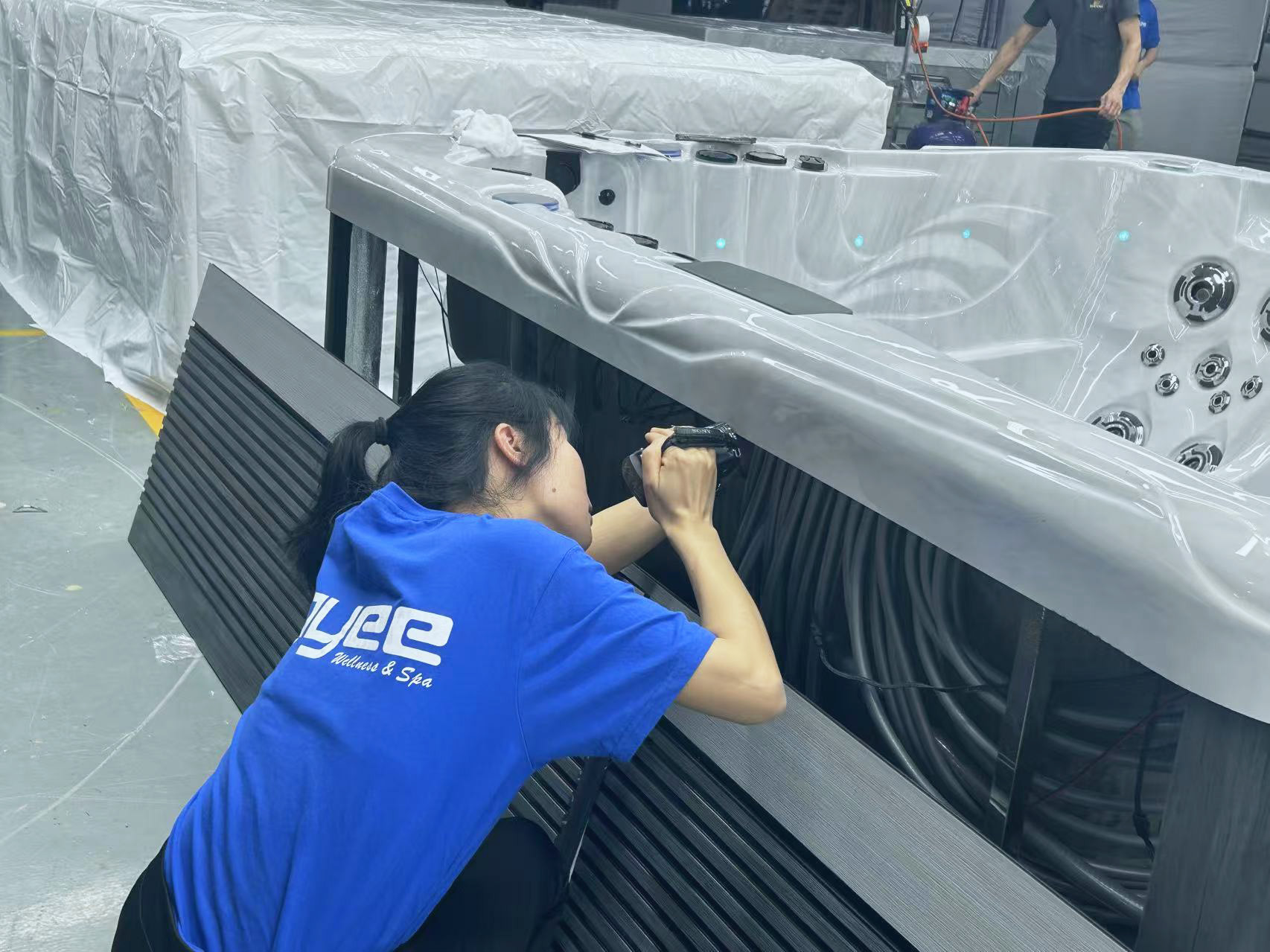
At JOYEE, every spa undergoes a 24-hour water test before delivery, covering sealing, water circulation, heating and insulation, and control system performance.
For bulk orders, quality should be treated as a system—not a final inspection step.
7. Can They Meet Market-Specific Requirements?
A hot tub designed for one market may not be suitable for another.
When working with international distributors and project buyers, the OEM manufacturer should understand that different countries may have different requirements for electrical systems, certifications, documentation, packaging, labeling, and product configuration.
Before placing a large order, discuss requirements such as:
- Electrical specifications
- Applicable certifications
- Country-specific configurations
- Product labels
- User manuals
- Warning labels
- Packaging specifications
- Shipping requirements
- Private-label requirements
A manufacturer with international OEM experience should be able to incorporate these requirements into the production process rather than treating them as an afterthought.
This is especially important for buyers distributing products across multiple countries.
8. Can They Keep Large Orders on Schedule?
For project buyers, delayed production can create problems far beyond the factory itself.
A delayed hot tub shipment may affect installation schedules, hotel openings, resort construction, warehouse planning, promotions, and customer commitments.
That is why large-scale manufacturing requires more than simply having a short lead time.
A capable OEM manufacturer should coordinate:
Production Planning → Component Procurement → Capacity Allocation → Assembly → Quality Inspection → Packaging → Shipment Scheduling
For multi-model projects, production planning becomes even more important.
The manufacturer needs to coordinate different components, production lines, quantities, and delivery dates while maintaining consistent quality throughout the project.
Reliable project execution means not only producing the products, but also delivering them according to the agreed schedule.
9. Can They Support Private Label and Project Branding?
For many distributors and brands, OEM cooperation goes far beyond manufacturing.
A complete private-label hot tub solution may involve:
- Logo integration
- Product name and model numbers
- Cabinet branding
- Product labels
- Packaging
- User manuals
- Marketing materials
- Customized accessories
- Exclusive product designs
For hotel groups, resort developers, and large commercial projects, branding can also be incorporated into the product itself.
A strong OEM manufacturer should therefore provide flexible private label and branding support while maintaining consistent product quality across large production batches.
For established distributors, the ideal long-term partner is not simply a factory that produces products under your name, but a manufacturer that can help you build and expand your own product portfolio.
10. What Happens After Mass Production?
The relationship between an OEM manufacturer and a large-volume buyer should not end when the container leaves the factory.
For distributors and project customers, long-term support can be just as important as the initial production.
Consider whether the manufacturer can provide:
- Spare parts
- Replacement components
- Warranty support
- Technical assistance
- Product documentation
- Troubleshooting support
- After-sales communication
- Long-term component availability
This becomes particularly important for hotel, resort, holiday park, and other commercial projects where multiple units may operate simultaneously.
A reliable OEM partner should be prepared to support the products throughout their commercial lifecycle—not simply complete the initial order.
From Product Concept to Container Delivery
For large-volume and project-based buyers, manufacturing capability is ultimately about execution.
The right hot tub OEM manufacturer should be able to connect every stage of the process:
Project Brief
↓
Product Development
↓
Customization & Engineering
↓
Sampling & Testing
↓
Multi-SKU Production
↓
Quality Control
↓
Compliance & Private Label
↓
Production Scheduling
↓
Container Loading & Delivery
↓
Long-Term Project Support
This is the difference between simply purchasing hot tubs and building a reliable OEM supply partnership.
Why Choose JOYEE for Large-Scale Hot Tub Projects?
With more than 20 years of experience in spa manufacturing, JOYEE provides integrated hot tub OEM & ODM solutions for distributors, wholesalers, hospitality groups, project developers, and commercial buyers worldwide.
Our manufacturing capabilities include:
- 50,000 m² Manufacturing Facility
- 26,000+ Spa Units Annual Capacity
- 73% Automated Production
- OEM & ODM Product Development
- Custom Mold Development
- Multi-Model & Multi-Configuration Production
- Flexible Component Selection
- 24-Hour Water Testing
- Private Label & Branding Support
- Container-Scale Logistics
From product concept and customized development to mass production, quality inspection, and final shipment, JOYEE supports customers throughout the complete project lifecycle.
Whether you are developing a new private-label hot tub range, sourcing products for a hotel or resort project, or planning large-volume distribution, our goal is simple:
From Product Concept to Container Delivery.
Looking for a Hot Tub OEM Manufacturer for Your Next Project?
Share your product requirements, target market, estimated quantity, or project specifications with our team.
JOYEE can help evaluate the right product configuration and develop a scalable OEM solution for your business.