
Introduction: The Right Supplier Is More Than a Product Provider
For large distributors, wholesalers, and project buyers, selecting an outdoor spa supplier is not simply a comparison of product specifications, pricing, or appearance. Behind every successful spa project is a manufacturing partner capable of delivering consistent quality, flexible customization, and reliable long-term support.
With over 20 years of experience in outdoor spa manufacturing, JOYEE has worked with global partners to develop and produce customized spa solutions for residential, commercial, and hospitality applications. As an OEM and ODM manufacturer, JOYEE understands that large-scale buyers need more than finished products — they need a stable supply chain, professional engineering support, and the ability to adapt products to different market requirements.
Capacity, dimensions, jet numbers, and pricing are important, but they only represent the visible side of a product.
The real value of an outdoor spa supplier is reflected in:
- Consistent product quality across large-volume orders
- Flexible customization capabilities
- Stable production capacity
- Reliable component integration
- Efficient after-sales support
Two spas may appear similar in catalogs, share the same seating capacity, and even use comparable specifications. However, their performance in real market conditions can be completely different.
The difference comes from the manufacturing capability behind the product:
- Engineering standards
- Production control
- Material selection
- Quality inspection processes
- Supplier response capability
For wholesale partners, the goal is not only to purchase a spa.
The goal is to build a reliable product supply chain that supports long-term market growth.
1. Product Evaluation: Beyond Capacity and Appearance
1.1 Why Product Specifications Are Not Enough
When purchasing outdoor spas in bulk, many buyers begin with basic specifications:
- Seating capacity
- Dimensions
- Jet quantity
- Available features
- Unit price
However, these specifications do not always reflect actual market performance.
A commercially successful spa must balance:
- User comfort
- Functional design
- Durability
- Energy efficiency
- Maintenance requirements
For example, two five-person spas may have similar dimensions, but differences in internal structure, seat design, and plumbing layout can significantly affect customer experience.
For distributors, these differences directly influence:
- Customer satisfaction
- Dealer reputation
- Warranty costs
- Repeat orders
1.2 Commercial Product Design Considerations
A product designed for wholesale markets should consider more than individual user experience.
Professional buyers should evaluate:
User Experience
- Practical seating layout
- Ergonomic support
- Comfortable space distribution
- Different user requirements
Market Adaptability
- Residential applications
- Rental properties
- Hotels and resorts
- Premium outdoor projects
Long-Term Performance
- Structural durability
- Energy efficiency
- Maintenance convenience
A successful product should not only attract customers at the showroom level but also perform reliably after years of use.
2. Engineering Capability: The Foundation of Long-Term Supply
2.1 Shell Construction and Structural Reliability
For large-volume buyers, product consistency is critical.
A reliable spa manufacturer should have strict control over:
- Acrylic quality
- Fiberglass reinforcement
- Shell thickness
- Structural support
- Base protection
The shell is not only the visible surface of the spa. It determines:
- Long-term appearance
- Structural stability
- Resistance to daily usage
A strong manufacturing process ensures that every unit delivered to customers maintains consistent quality.
2.2 Insulation and Energy Efficiency for Different Markets
Outdoor spas are sold across different climates and regions.
Therefore, insulation performance becomes an important factor for distributors.
Professional buyers should evaluate:
- Insulation materials
- Thermal retention performance
- Cover quality
- Climate adaptation solutions
A properly insulated spa helps:
- Reduce operating costs
- Improve customer experience
- Support sales in colder markets
For distributors, energy efficiency can become a competitive advantage when positioning products in the market.
3. Hydrotherapy System: Designing Real Customer Value
3.1 Beyond Jet Numbers
In competitive markets, jet quantity is often used as a selling point.
However, experienced buyers understand that hydrotherapy performance depends on the complete system.
Key evaluation factors include:
- Jet positioning
- Pump configuration
- Plumbing efficiency
- Water pressure balance
- Massage zone design
A professional spa manufacturer should focus on creating effective therapy experiences rather than simply increasing component numbers.
3.2 Component Integration and Reliability
For wholesale projects, component reliability directly affects after-sales performance.
Important considerations include:
- Control system quality
- Pump stability
- Filtration efficiency
- Electrical compatibility
Working with established component suppliers helps ensure:
- Easier maintenance
- Better technical support
- Lower replacement risk
4. Manufacturing Capability: The Key Difference Between Suppliers
4.1 Production Capacity and Consistency
For large distributors, supply stability is as important as product quality.
Before cooperation, buyers should evaluate:
- Factory production capacity
- Manufacturing equipment
- Workforce capability
- Quality control procedures
- Delivery reliability
A supplier should be able to maintain consistent quality from the first container to long-term cooperation.
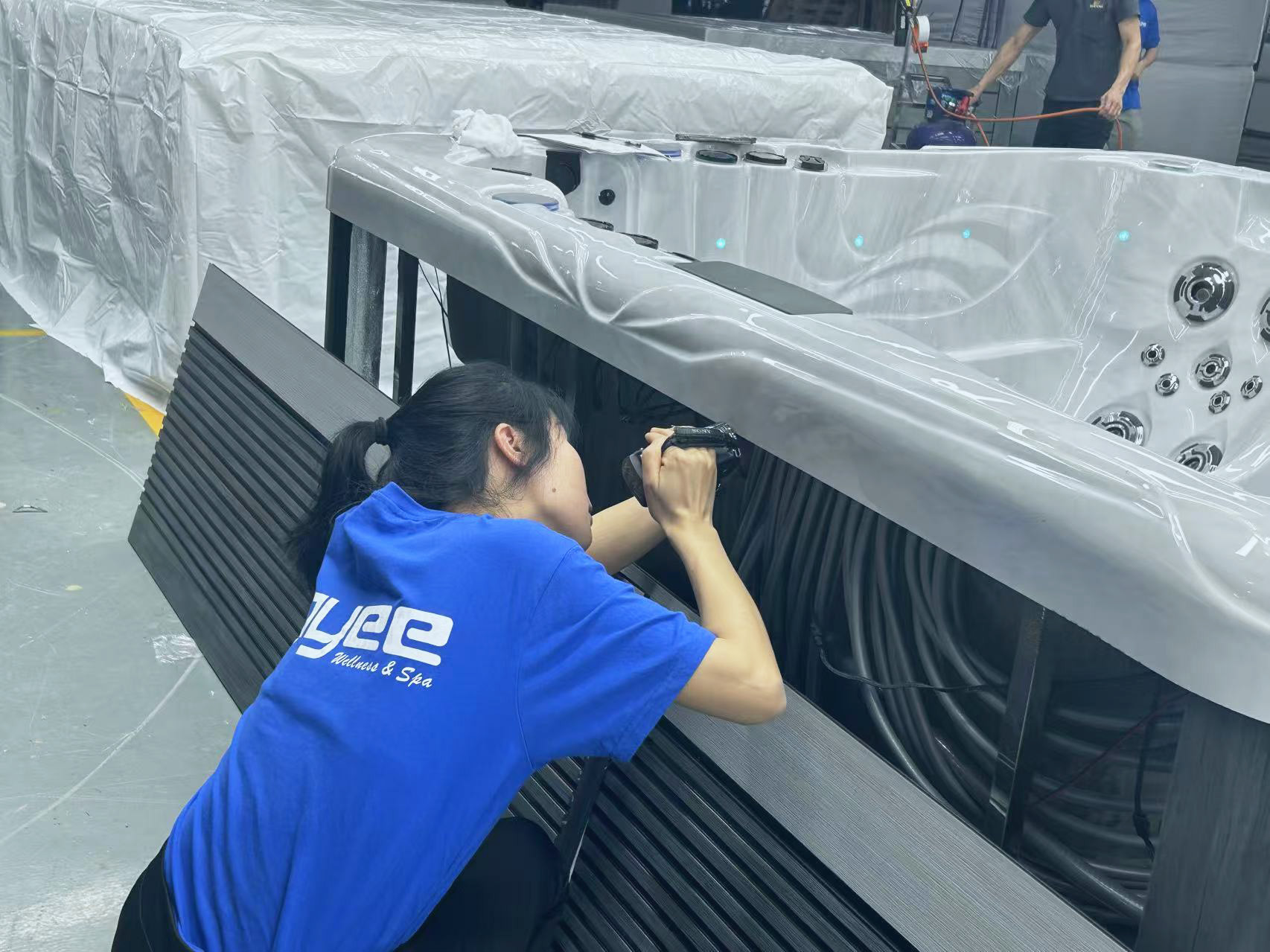
4.2 Quality Control and Factory Verification
Professional buyers should request evidence including:
- Production inspection records
- Water testing procedures
- Electrical testing
- Final quality inspection
- Packaging standards
A reliable manufacturer should provide transparent quality documentation to support purchasing decisions.
5. Customization Capability: Supporting Different Market Strategies
5.1 OEM and Private Label Programs
Large distributors often require products adapted to their own market positioning.
A capable manufacturing partner should support:
- Private label branding
- Custom colors
- Feature configuration
- Product modifications
- Packaging customization
OEM capability allows partners to develop differentiated products instead of competing only on price.
5.2 Project-Based Solutions
For hospitality, commercial, and real estate projects, standard products may not always meet requirements.
Project buyers may need:
- Specific dimensions
- Special configurations
- Multiple model combinations
- Customized appearance solutions
A professional supplier should provide flexible engineering support from concept development to final production.
6. After-Sales Support: Reducing Long-Term Business Risk
6.1 Why Service Capability Matters for Wholesale Partners
When selling hundreds or thousands of units, after-sales support becomes a major business factor.
Buyers should evaluate:
- Spare parts availability
- Technical documentation
- Troubleshooting support
- Warranty procedures
- Response efficiency
A supplier that supports distributors after shipment helps protect their brand reputation in the market.
6.2 Building a Sustainable Partnership
The strongest supplier relationships are based on cooperation, not only transactions.
Long-term partners should provide:
- Product improvement suggestions
- Market feedback support
- Technical communication
- Continuous customization assistance
A reliable manufacturer becomes an extension of the distributor's supply chain.
7. JOYEE: Your Partner for Customized Outdoor Spa Manufacturing
With over 20 years of experience in outdoor spa manufacturing, Guangzhou Joyee Wellness Technology Co., Ltd. provides OEM and ODM solutions for global distributors, wholesalers, and project partners.
JOYEE supports partners through:
- Customized outdoor hot tub manufacturing
- Private label solutions
- Large-volume production
- Project-based spa solutions
- Professional quality control processes
From product development and shell production to component integration and final inspection, JOYEE focuses on creating reliable spa solutions that help partners grow their businesses.
With professional manufacturing capabilities and flexible customization support, JOYEE works with global partners to develop products suitable for different markets and applications.
Conclusion: Choose a Manufacturing Partner, Not Just a Product
For large distributors and project buyers, the right outdoor spa supplier is not simply the company offering the lowest price.
A successful partnership requires:
- Reliable product engineering
- Stable manufacturing capability
- Flexible customization support
- Strong quality control
- Long-term technical cooperation
The difference between suppliers is not always visible in a product catalog.
It is reflected in every unit delivered, every customer experience created, and every project successfully completed.
When selecting an outdoor spa manufacturing partner, look beyond specifications.
Choose a supplier that can support your growth.